



• USAID
  • PACE
  • PRB

Median Age Is Key to Development Metrics- DRAFT v2

Draft- Family planning is an essential component of
sustainable development---end-

Fertility and age structure

Fertility and age structure

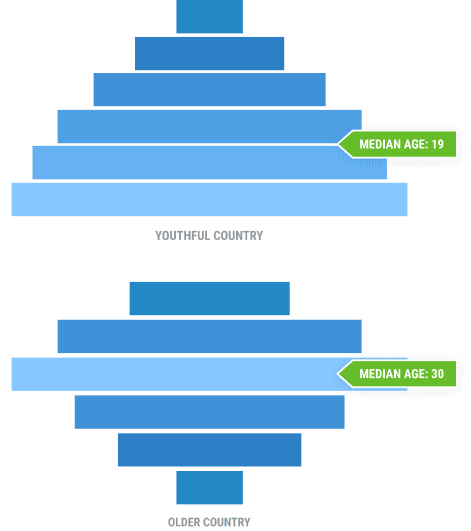
Declines in fertility are a key driver of a maturing age structure.

Family planning is essential to sustainable development. Many low-income countries have high total fertility rates and youthful population age structures, with the majority less than 25 years old.

Access to voluntary family planning leads to decreases in the total fertility rate by enabling women and couples to choose whether, when, and how often to have children. Declines in fertility lead to changes in the age structure of the population, decreasing the share younger than 15 and increasing the share in the productive working ages.

One way to measure this change in population age structure is by looking at the median age of the population. Median age is the age at which half of a country’s population is older, and half is younger.

Demographic Window of Opportunity

Demographic Window of Opportunity

As youthful countries go through the age structure transition, they enter a window of opportunity for accelerated economic development.

When the median age of the population is between 26 and 40 years, countries enter a demographic window of opportunity to achieve accelerated economic growth and benefits across a range of development sectors. With government policies that promote job opportunities for the working-age population, countries may experience improvements in many measures of sustainable development during this window.

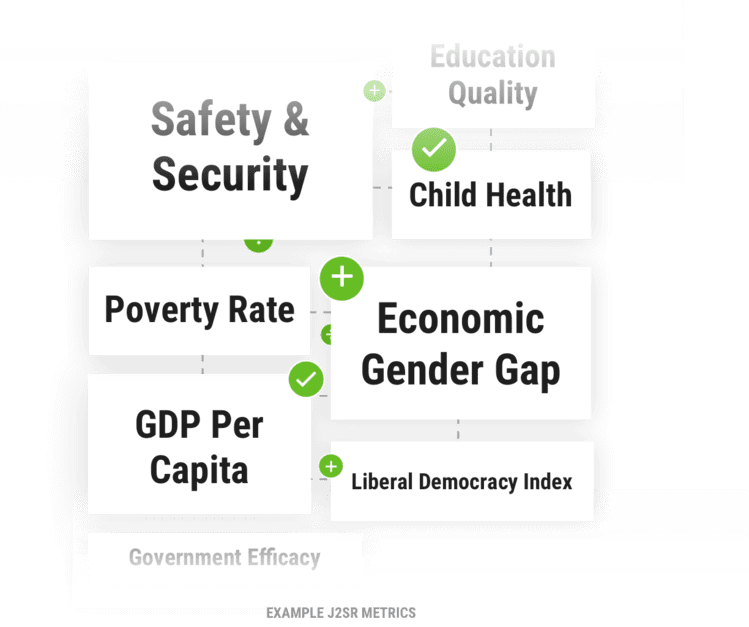
To examine the impact of family planning on a country’s path to sustainable development, we selected eight metrics of sustainable development that had an evidence-based relationship with age structure:

• Liberal democracy index.
• Safety and security.
• GDP per capita.
• Poverty rate.
• Child health.
• Education quality.
• Government effectiveness.
• Economic gender gap.

Median Age and Sustainable Development

Median Age and Sustainable Development

Youthful age structures act as a
constraint to sustainable
development.

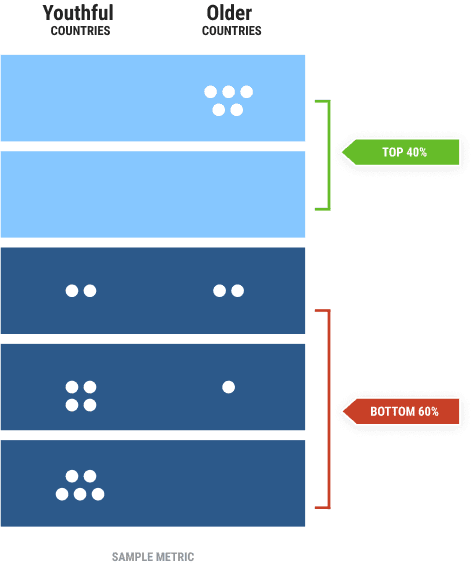
Our analysis shows that youthful countries can make progress on selected metrics, but that progress is limited. When sorting scores on a given metric into quintiles, or five equally sized groups from the lowest 20 percent to the highest 20 percent of scores, youthful countries have a difficult time advancing from the bottom three quintiles, or bottom 60 percent, of any given metric.

Countries with a median age less than 26 have a low probability of reaching the top two quintiles, or top 40 percent, of any metric without first experiencing decreases in total fertility that lead to changes in population age structure. In other words, youthful age structure acts as a constraint to sustainable development. To overcome this constraint, countries must make investments to strengthen their family planning policies and programs and ensure that all women and couples have access to voluntary family planning services.

Analysis of Eight Metrics of Sustainable Development

Explore our interactive visuals to learn more about the robust relationship between family planning, age structure, and these metrics of sustainable development. We developed a series of quintiles probability line charts, scatterplots, and maps highlighting the data for these metrics and their relationship to median age.

Choose one of the 8 Metrics: (show all)

GDP Per Capita

Poverty Rate

Child Health

Education Quality

Liberal Democracy Index

Safety and Security

Government Effectiveness

Economic Gender Gap

GDP Per Capita

Poverty Rate

Child Health

Education Quality

Liberal Democracy Index

Safety and Security

Government Effectiveness

Economic Gender Gap

Array ( [0] => Array ( [point_area_color] => #e9f3ff [point_axis_y_pos] => 95 [point_axis_x_pos] => 14 [point_text_values] => < 2,500 [point_title] => Low [point_tooltip_text] => Youthful age structures act as a constraint to sustainable development. ) [1] => Array ( [point_area_color] => #c8d7ea [point_axis_y_pos] => 95 [point_axis_x_pos] => 27 [point_text_values] => 2,500 - 5,999 [point_title] => Low - Middle [point_tooltip_text] => Population Reference Bureau. All Rights Reserved. Privacy Policy ) [2] => Array ( [point_area_color] => #5392d2 [point_axis_y_pos] => 95 [point_axis_x_pos] => 36 [point_text_values] => 6,000 - 12,499 [point_title] => Middle [point_tooltip_text] => Lorem ipsum dolor sit amet, consectetur adipiscing elit. ) [3] => Array ( [point_area_color] => #559465 [point_axis_y_pos] => 95 [point_axis_x_pos] => 46 [point_text_values] => 12,500 - 31,499 [point_title] => Upper Middle [point_tooltip_text] => Integer tempus interdum sapien fringilla egestas. ) [4] => Array ( [point_area_color] => #7cba43 [point_axis_y_pos] => 95 [point_axis_x_pos] => 60 [point_text_values] => > 31,500 [point_title] => High [point_tooltip_text] => Probability of a Country Being in a GDP Segment by Median Age ) )
Choose a data visualization:

The Results

GDP per Capita

GDP Per Capita

GDP per Capita is the sum of gross value added by all resident producers inthe economy, plus any product taxes, minus any subsidies not included in the value of the products, divided by the population. It is calculated without deductions for depreciation of fabricated assets or for depletion and degradation of natural resources. Data are made comparable across countries by converting GDP to international dollars using purchasing power parity (PPP) exchange rates.

The quintiles probability line graph featuring the logistic regression analysis illustrates how a country’s probability of being in the top two quintiles of GDP per capita increases as median age increases. The threshold for having a 50% probability of being in the top two quintiles of GDP per capita is a median age of 30.

The scatterplot illustrates the relationship between median age and the logof GDP per capita in the countries included for analysis. The map allows users to visualize the geographic patterns behind country GDP per capita values.

The findings illustrate a statistically significant linear relationship: As the median age of the population increases, GDP per capita also tends to increase. Almost all countries with a median age less than 20 years have GDPs per capita less than $6,000. Examples of countries in this category include Tanzania and Uganda, with median ages of 17.9 years and 16.6 years, respectively. Conversely, almost all countries with median ages within the demographic window of opportunity (between ages 26 and 40) have GDPs per capita above $6,000. In countries where the median age has surpassed 30 years, the GDP per capita indicator often reaches $10,000 or above. An example is Brazil, with a median age of 33.1 and a GDP per capita of nearly $15,000. Only when countries reach a median ageof 40 years are they likely to attain a GDP per capita above $30,000. For instance, Japan and France both have a median age above 40 years and the GDP per capita is above $40,000. To illustrate the connection between median age and GDP per capita: No country with a median age less than 30 years has GDP per capita above $30,000, while no country with a median age of 30 or greater has a GDP per capita less than $8,000.

Source: World Bank, “GDP per Capita, PPP (constant 2017 international $),” World Bank Data.

GDP per Capita

Illustrates the relationship between median age and the given metric of sustainable development in the countries included for analysis for the most recent year or years with available data | Scatterplot

Best viewed in expanded mode

y = x
r2 = 0.764

GDP per Capita

Provides a logistic regression analysis illustrating the probability of a country with a given median age reaching each quintile for the given metric of sustainable development | Quintiles Probability Line Graph

Best viewed in expanded mode
GDP per Capita

Plots country values for a metric of sustainable development for the most recent year or years with available data | Heat Map

Best viewed in expanded mode
  • < 2,500
  • 2,500 - 5,999
  • 6,000 - 12,499
  • 12,500 - 31,499
  • > 31,500
  • No Data
Array ( [0] => Array ( [point_area_color] => #e9f3ff [point_axis_y_pos] => 65 [point_axis_x_pos] => 11 [point_text_values] => 67 - 100 [point_title] => Low [point_tooltip_text] => Youthful age structures act as a constraint to sustainable development. ) [1] => Array ( [point_area_color] => #c8d7ea [point_axis_y_pos] => 65 [point_axis_x_pos] => 24 [point_text_values] => 37,1 - 67 [point_title] => Low - Middle [point_tooltip_text] => Population Reference Bureau. All Rights Reserved. Privacy Policy ) [2] => Array ( [point_area_color] => #5392d2 [point_axis_y_pos] => 65 [point_axis_x_pos] => 31 [point_text_values] => 12,1 - 37 [point_title] => Middle [point_tooltip_text] => Lorem ipsum dolor sit amet, consectetur adipiscing elit. ) [3] => Array ( [point_area_color] => #559465 [point_axis_y_pos] => 65 [point_axis_x_pos] => 38 [point_text_values] => 2,1 - 12 [point_title] => Upper Middle [point_tooltip_text] => Integer tempus interdum sapien fringilla egestas. ) [4] => Array ( [point_area_color] => #7cba43 [point_axis_y_pos] => 65 [point_axis_x_pos] => 52 [point_text_values] => < 2 [point_title] => High [point_tooltip_text] => Probability of a Country Being in a GDP Segment by Median Age ) )
Choose a data visualization:

The Results

Poverty Rate

Poverty Rate

Poverty Rate is measured using a relatively ambitious poverty line of $5.00 per day, in purchasing power parity (PPP) terms. This indicator measures the percentage of a country’s population living on less than $5.00 a day, standardized across countries using PPP exchange rates.

The quintiles probability line graph featuring the logistic regression analysis illustrates how a country’s probability of being in the top two quintiles of the lowest poverty rate increases as median age increases. The threshold for having a 50% probability of being in the top two quintiles of the lowest poverty rate is a median age of 33.

This scatterplot illustrates the relationship between median age and poverty rate in the countries included for analysis. The map allows users to visualize the geographic patterns behind country poverty rate values. The findings illustrate a statistically significant linear relationship: As the median age of the population increases, the poverty rate tends to decrease. Almost all countries with a median age less than 20 years have poverty rates above 70%. Examples of countries in this category include Ethiopia and Malawi, with median ages of 18.3 years and 17.7 years, respectively. Conversely, almost all countries with median ages within the demographic window of opportunity (between ages 26 and 40) have poverty rates below 50%. In countries where the median age has surpassed 30 years, the poverty rate tends to fall more consistently at 40% and below. An example is Colombia, with a median age of 30.9 and a poverty rate of 28%. Only when countries reach a median age of 40 years are they likely to attain a poverty rate below 10%. For instance, Belgium and the Czech Republic both have a median age above 40 years and a poverty rate at or below 0.5%.  To illustrate the connection between median age and poverty rate: No country with a median age less than 25 years has a poverty rate less than 20%, while no country with a median age of 30 or greater has a poverty rate greater than 50%.

Source: World Bank, “PovcalNet” World Bank Data.

Poverty Rate

Illustrates the relationship between median age and the given metric of sustainable development in the countries included for analysis for the most recent year or years with available data | Scatterplot

Best viewed in expanded mode

y = x
r2 = 0.764

Poverty Rate

Provides a logistic regression analysis illustrating the probably of a country with a given median age reaching each quintile for the given metric of sustainable development | Quintiles probability line graph

Best viewed in expanded mode
Poverty Rate

Plots country values for a metric of sustainable development for the most recent year or years with available data | Heat Map

Best viewed in expanded mode
  • < 2.10
  • 2.10 - 12.09
  • 12.10 - 37.09
  • 37.10 - 66.99
  • > 67.00
  • No Data
Array ( [0] => Array ( [point_area_color] => #e9f3ff [point_axis_y_pos] => 95 [point_axis_x_pos] => 16 [point_text_values] => > 50.1 [point_title] => Low [point_tooltip_text] => Youthful age structures act as a constraint to sustainable development. ) [1] => Array ( [point_area_color] => #c8d7ea [point_axis_y_pos] => 95 [point_axis_x_pos] => 23 [point_text_values] => 18,1 - 50 [point_title] => Low - Middle [point_tooltip_text] => Population Reference Bureau. All Rights Reserved. Privacy Policy ) [2] => Array ( [point_area_color] => #5392d2 [point_axis_y_pos] => 95 [point_axis_x_pos] => 31 [point_text_values] => 5,1 - 18 [point_title] => Middle [point_tooltip_text] => Lorem ipsum dolor sit amet, consectetur adipiscing elit. ) [3] => Array ( [point_area_color] => #559465 [point_axis_y_pos] => 95 [point_axis_x_pos] => 41 [point_text_values] => 2,1 - 5 [point_title] => Upper Middle [point_tooltip_text] => Integer tempus interdum sapien fringilla egestas. ) [4] => Array ( [point_area_color] => #7cba43 [point_axis_y_pos] => 95 [point_axis_x_pos] => 50 [point_text_values] => < 2 [point_title] => High [point_tooltip_text] => Probability of a Country Being in a GDP Segment by Median Age ) )
Choose a data visualization:

The Results

Child Health

Child Health

The Child Health metric in this analysis is measured using the child mortality rate from the Center for International Earth Science Information Network’s child health indicators. The child mortality rate is the probability of a child dying between the age 1 and his or her fifth birthday, expressed as deaths per 1,000 live births.

The quintiles probability line graph featuring the logistic regression analysis illustrates how a country’s probability of being in the top two quintiles of child health (low child mortality rate) increases as median age increases. The threshold for having a 50% probability of being in the top two quintiles of child health is a median age of 29.

This scatterplot illustrates the statistical relationship between median age and child mortality in the countries included for analysis. The map allows users to visualize the geographic patterns behind country child health values. The findings demonstrate a statistically significant linear relationship: As the median age of the population increases, child mortality tends to decrease. Almost all countries with a median age of fewer than 20 years have a high infant and neonatal mortality rates. Countries in this category include the Democratic Republic of Congo, Liberia, Mali, and Nigeria, with median ages 16.9, 19.3, 16.3, and 18 years. In all these three countries, child mortality spans between 20 and 46.5 deaths per 1,000 live births. Conversely, almost all countries with median ages within the demographic window of opportunity (between the ages of 26 and 40) have child mortality rates lower than ten deaths per 1,000 live births. In countries where median age surpassed 30 years, child mortality rates fall significantly below ten deaths per 1,000 live births. Only when countries reach 40 years and above that child mortality fall to two deaths or less per 1,000 live births. For instance, Cuba has a median age of more than 40 years and a child mortality rate is 1.3 deaths per 1,000 live births. To illustrate the connection between median age and child health: No country with a median age less than 25 years has a child mortality rate below 10 deaths per 1,000 live births, while no country with a median age of 26 years or greater has a child mortality rate above ten deaths per 1,000 live births.

Source: Center for International Earth Science Information Network (CIESIN), Columbia University, “Natural Resource Protection and Child Health Indicators, 2019 Release (2010-2019),” (Palisades, NY: National Aeronautics and Space Administration (NASA) Socioeconomic Data and Applications Center (SEDAC), 2019).

Child Health

Illustrates the relationship between median age and the given metric of sustainable development in the countries included for analysis for the most recent year or years with available data | Scatterplot

Best viewed in expanded mode

y = x
r2 = 0.764

Child Health

Provides a logistic regression analysis illustrating the probably of a country with a given median age reaching each quintile for the given metric of sustainable development | Quintiles probability line graph

Best viewed in expanded mode
Child Health

Plots country values for a metric of sustainable development for the most recent year or years with available data | Heat Map

Best viewed in expanded mode
  • < 2.10
  • 2.10 - 5.09
  • 5.10 - 18.09
  • 18.10 - 50.09
  • > 50.10
  • No Data
Array ( [0] => Array ( [point_area_color] => #e9f3ff [point_axis_y_pos] => 95 [point_axis_x_pos] => 15 [point_text_values] => < 3 [point_title] => Low [point_tooltip_text] => Youthful age structures act as a constraint to sustainable development. ) [1] => Array ( [point_area_color] => #c8d7ea [point_axis_y_pos] => 95 [point_axis_x_pos] => 26 [point_text_values] => 3 - 4,49 [point_title] => Low - Middle [point_tooltip_text] => Population Reference Bureau. All Rights Reserved. Privacy Policy ) [2] => Array ( [point_area_color] => #5392d2 [point_axis_y_pos] => 95 [point_axis_x_pos] => 35 [point_text_values] => 5,5 - 7,99 [point_title] => Middle [point_tooltip_text] => Lorem ipsum dolor sit amet, consectetur adipiscing elit. ) [3] => Array ( [point_area_color] => #559465 [point_axis_y_pos] => 95 [point_axis_x_pos] => 43 [point_text_values] => 8 - 10,49 [point_title] => Upper Middle [point_tooltip_text] => Integer tempus interdum sapien fringilla egestas. ) [4] => Array ( [point_area_color] => #7cba43 [point_axis_y_pos] => 95 [point_axis_x_pos] => 54 [point_text_values] => 10,5 - 13 [point_title] => High [point_tooltip_text] => Probability of a Country Being in a GDP Segment by Median Age ) )
Choose a data visualization:

The Results

Education Quality

Education Quality

Education Quality is measured using the Learning-Adjusted Years of Schooling (LAYS) indicator. This indicator includes two parts:

  1. Expected years of schooling, which is the average number of years of schooling a child born today can expect to receive by age 18.
  2. Harmonized test scores from major international and regional student achievement testing programs, as a marker of the quality of the education system.

This scatterplot illustrates the relationship between median age and LAYS in the countries included for analysis. The map allows users to visualize the geographic patterns behind country education quality values. The findings illustrate a statistically significant linear relationship: As the median age of the population increases, education quality (measured by LAYS) also tends to increase. Almost all countries with a median age less than 20 years have average education quality scores less than six LAYS. Examples of countries in this category include Ethiopia and Malawi, with median ages of 19.5 years and 18 years, respectively. Conversely, almost all countries with median ages within the demographic window of opportunity (between ages 26 and 40) have education quality scores greater than six LAYS. In countries where the median age has surpassed 30 years, education quality scores often reach seven LAYS or above. An example is Brazil, with a median age of 33.5 and nearly eight LAYS. Only when countries reach median age of 40 years are they likely to attain an education quality score above 10 LAYS. For instance, Sweden and South Korea both have a median age above 40 years and an education quality score approaching 12 LAYS. To illustrate the connection between median age and education quality: No country with a median age less than 30 years has an education quality score greater than nine LAYS, while no country with a median age of 30 years or greater has a score less than six LAYS.

Source: World Bank, “Human Capital Index, Learning-Adjusted Years of Schooling Indicator.”

Education Quality

Illustrates the relationship between median age and the given metric of sustainable development in the countries included for analysis for the most recent year or years with available data | Scatterplot

Best viewed in expanded mode

y = x
r2 = 0.764

Education Quality

Quintiles Probability Line Graph

Best viewed in expanded mode
Education Quality

Plots country values for a metric of sustainable development for the most recent year or years with available data | Heat Map

Best viewed in expanded mode
  • < 3.00
  • 3.00 - 5.49
  • 5.50 - 7.99
  • 8.00 - 10.49
  • > 10.50
  • No Data
Array ( [0] => Array ( [point_area_color] => #e9f3ff [point_axis_y_pos] => 5 [point_axis_x_pos] => -54 [point_text_values] => < 0,08 [point_title] => Low [point_tooltip_text] => Youthful age structures act as a constraint to sustainable development. ) [1] => Array ( [point_area_color] => #c8d7ea [point_axis_y_pos] => 5 [point_axis_x_pos] => -13 [point_text_values] => 0,08 - 0,15 [point_title] => Low - Middle [point_tooltip_text] => Population Reference Bureau. All Rights Reserved. Privacy Policy ) [2] => Array ( [point_area_color] => #5392d2 [point_axis_y_pos] => 5 [point_axis_x_pos] => 6 [point_text_values] => 0,16 - 0,37 [point_title] => Middle [point_tooltip_text] => Lorem ipsum dolor sit amet, consectetur adipiscing elit. ) [3] => Array ( [point_area_color] => #559465 [point_axis_y_pos] => 5 [point_axis_x_pos] => 19 [point_text_values] => 0,38 - 0,69 [point_title] => Upper Middle [point_tooltip_text] => Integer tempus interdum sapien fringilla egestas. ) [4] => Array ( [point_area_color] => #7cba43 [point_axis_y_pos] => 5 [point_axis_x_pos] => 38 [point_text_values] => 0,7 - 1 [point_title] => High [point_tooltip_text] => Probability of a Country Being in a GDP Segment by Median Age ) )
Choose a data visualization:

The Results

Liberal Democracy Index

Liberal Democracy Index

Liberal Democracy is measured using the freedom of expression and association indicator. This indicator includes two main components:

  1. Electoral democracy component (measured on five indices): Freedom of association, clean elections, freedom of expression and alternative sources of information, elected officials, and suffrage.
  2. Liberal democracy (focused on three components): Equality before the law and individual rights, judicial constraints on the executive branch, and legislative constraints on the branch.

The quintiles probability line graph featuring the logistic regression analysis illustrates how a country’s probability of being in the top two quintiles of liberal democracy increases as median age increases. The threshold for having a 50% probability of being in the top two quintiles of liberal democracy is a median age of 28.

This scatterplot illustrates the statistical relationship between median age and liberal democracy in the countries included for analysis. The map allows users to visualize the geographic patterns behind country liberal democracy values. The findings illustrate a statistically significant linear relationship: As the median age of the population increases, liberal democracy (measured by V-Dems) also tends to increase. Almost all the priority countries with a median age of less than 20 years have average liberal democracy scores lower than 0.6. Examples of countries in this category include South Sudan, the Democratic Republic of Congo, Ethiopia, and Nigeria, with median ages of 19.0 years, 17.0 years, 19.5 years, and 18.1 years. In all four countries, liberal democracy falls between 0 and 0.45 as the median age reaches 30; the liberal democracy index is more consistently above 0.4. This is the case with Brazil, with a median age of 33.5 and a liberal democracy index of 0.51. An exception is Turkey, where the median age is 31.5, but the V-Dems score is 0.10. Only when countries reach the median age of 40 or greater are they likely to have a liberal democracy score above 0.6. Examples are Germany and France, each with median ages above 40 and a liberal democracy index above 0.7. To illustrate the connection between median age and liberal democracy: Almost all countries with a median age below 25 years have a V-Dems score below 0.6. No country with a median age of 45 years or greater has a score less than 0.7.

Source: Varieties of Democracy (V-Dem) project, V-Dem Institute of the University of Gothenburg.

Liberal Democracy Index

Illustrates the relationship between median age and the given metric of sustainable development in the countries included for analysis for the most recent year or years with available data | Scatterplot

Best viewed in expanded mode

y = x
r2 = 0.764

Liberal Democracy Index

Quintiles probability line graph

Best viewed in expanded mode
Liberal Democracy Index

Plots country values for a metric of sustainable development for the most recent year or years with available data | Heat Map

Best viewed in expanded mode
  • < 0.08
  • 0.08 - 0.15
  • 0.16 - 0.37
  • 0.38 - 0.69
  • > 0.70
  • No Data
Array ( [0] => Array ( [point_area_color] => #e9f3ff [point_axis_y_pos] => 15 [point_axis_x_pos] => -41 [point_text_values] => < 56 [point_title] => Low [point_tooltip_text] => Youthful age structures act as a constraint to sustainable development. ) [1] => Array ( [point_area_color] => #c8d7ea [point_axis_y_pos] => 15 [point_axis_x_pos] => -1 [point_text_values] => 56 - 65,9 [point_title] => Low - Middle [point_tooltip_text] => Population Reference Bureau. All Rights Reserved. Privacy Policy ) [2] => Array ( [point_area_color] => #5392d2 [point_axis_y_pos] => 15 [point_axis_x_pos] => 14 [point_text_values] => 66 - 70,9 [point_title] => Middle [point_tooltip_text] => Lorem ipsum dolor sit amet, consectetur adipiscing elit. ) [3] => Array ( [point_area_color] => #559465 [point_axis_y_pos] => 15 [point_axis_x_pos] => 31 [point_text_values] => 71 - 81,9 [point_title] => Upper Middle [point_tooltip_text] => Integer tempus interdum sapien fringilla egestas. ) [4] => Array ( [point_area_color] => #7cba43 [point_axis_y_pos] => 15 [point_axis_x_pos] => 65 [point_text_values] => 82 - 100 [point_title] => High [point_tooltip_text] => Probability of a Country Being in a GDP Segment by Median Age ) )
Choose a data visualization:

The Results

Safety and Security

Safety and Security

Safety and Security is measured using the Legatum’s safety and security pillar. This pillar measures the degree to which individuals and communities are free from:

  • War and civil conflicts.
  • Terrorism.
  • Politically related terror.
  • Violent crimes.
  • Property crime.

The pillar gauges whether these forms of violence and crime have destabilized the security of individuals both immediately and through longer-lasting effects.

The quintiles probability line graph featuring the logistic regression analysis illustrates how a country’s probability of being in the top two quintiles of safety and security increases as median age increases. The threshold for having a 50% probability of being in the top two quintiles of safety and security is a median age of 28.

This scatterplot illustrates the relationship between median age and Legatum Prosperity Index score in the countries included in the analysis. The map allows users to visualize the geographic patterns behind country safety and security values. The findings demonstrate a statistically significant linear relationship: As median age increases, so does the safety and security index. Almost all countries with a median age of less than 20 years have average Legatum’s scores lower than 40. Examples of countries in this category include the Democratic Republic of Congo and South Sudan, with median ages of 16.9 years and 18.9 years. In both countries, the Legatum’s scores fall below 40, with both countries scoring 33.3 and 19.2 correspondingly. Conversely, almost all countries with median ages within the demographic window of opportunity (between the ages of 26 and 40) have a safety and security score close to 80 or greater. Only when countries reach a median age of 40 years are they likely to attain safety and security. For instance, countries like Denmark and Switzerland, with median ages of 42.2 and 42.9, respectively, score 92.9 and 94 on the Legatum safety and security index. To illustrate the connection between median age and safety and security: No country with a median age less than 30 years has a Legatum safety and security score above 80.

Source: Legatum Institute, Legatum Prosperity Index.

Safety and Security

Illustrates the relationship between median age and the given metric of sustainable development in the countries included for analysis for the most recent year or years with available data | Scatterplot

Best viewed in expanded mode

y = x
r2 = 0.764

Safety and Security

Provides a logistic regression analysis illustrating the probably of a country with a given median age reaching each quintile for the given metric of sustainable development | Quintiles probability line graph

Best viewed in expanded mode
Safety and Security

Plots country values for a metric of sustainable development for the most recent year or years with available data | Heat Map

Best viewed in expanded mode
  • < 56
  • 56 - 65
  • 66 - 70
  • 71 - 81
  • > 82
  • No Data
Array ( [0] => Array ( [point_area_color] => #e9f3ff [point_axis_y_pos] => 75 [point_axis_x_pos] => -5 [point_text_values] => -3,0 - -0,96 [point_title] => Low [point_tooltip_text] => Youthful age structures act as a constraint to sustainable development. ) [1] => Array ( [point_area_color] => #c8d7ea [point_axis_y_pos] => 75 [point_axis_x_pos] => 21 [point_text_values] => -0,95 - -0,51 [point_title] => Low - Middle [point_tooltip_text] => Population Reference Bureau. All Rights Reserved. Privacy Policy ) [2] => Array ( [point_area_color] => #5392d2 [point_axis_y_pos] => 75 [point_axis_x_pos] => 30 [point_text_values] => -0,50 - -0,01 [point_title] => Middle [point_tooltip_text] => Lorem ipsum dolor sit amet, consectetur adipiscing elit. ) [3] => Array ( [point_area_color] => #559465 [point_axis_y_pos] => 75 [point_axis_x_pos] => 40 [point_text_values] => 0 - 0,84 [point_title] => Upper Middle [point_tooltip_text] => Integer tempus interdum sapien fringilla egestas. ) [4] => Array ( [point_area_color] => #7cba43 [point_axis_y_pos] => 75 [point_axis_x_pos] => 57 [point_text_values] => 0,85 - 3 [point_title] => High [point_tooltip_text] => Probability of a Country Being in a GDP Segment by Median Age ) )
Choose a data visualization:

The Results

Government Effectiveness

Government Effectiveness

The Government Effectiveness metric is drawn from nearly 50 indicators across 16 sources. Issue areas range from the quality of bureaucracy, public administration, and fiscal management; to coverage of and satisfaction with education, health, water, telecommunications, power, and transportation systems; to government policy and decision-making coherence, stability, and responsiveness.

The quintiles probability line graph featuring the logistic regression analysis illustrates how a country’s probability of being in the top two quintiles of government effectiveness increases as median age increases. The threshold for having a 50% probability of being in the top two quintiles of government effectiveness is a median age of 31.

This scatterplot illustrates the statistical relationship between median age and government effectiveness in the countries included for analysis. The map allows users to visualize the geographic patterns behind country government effectiveness values. The findings illustrate a statistically significant linear relationship: As the median age of the population increases, government effectiveness also tends to increase. Almost all countries with a median age less than 20 years have government effectiveness scores less than 0, and many have scores less than -1. Examples of countries in this category include Afghanistan and Madagascar, with median ages of 18.4 years and 19.6 years, respectively. Conversely, countries with median ages within the demographic window of opportunity (between the ages of 26 and 40) almost all have a government effectiveness score greater than -1. In countries where the median age has surpassed 35 years, the government effectiveness score often reaches 0 or above. An example is India, with a median age of 28.4 and a government effectiveness score of 0.3. Only when countries reach a median age of 40 years are they likely to attain a government effectiveness score above 1. For instance, Finland and the United Kingdom both have a median age above 40 years and government effectiveness scores above 1. To illustrate the connection between median age and government effectiveness: No country with a median age less than 25 years has a government effectiveness score greater than 0.5, while no country with a median age of 35 years or greater has a score less than -1.

Source: World Bank, Worldwide Governance Indicators.

Government Effectiveness

Illustrates the relationship between median age and the given metric of sustainable development in the countries included for analysis for the most recent year or years with available data | Scatterplot

Best viewed in expanded mode

y = x
r2 = 0.764

Government Effectiveness

Provides a logistic regression analysis illustrating the probably of a country with a given median age reaching each quintile for the given metric of sustainable development | Quintiles probability line graph

Best viewed in expanded mode
Government Effectiveness

Plots country values for a metric of sustainable development for the most recent year or years with available data | Heat Map

Best viewed in expanded mode
  • < -0.95
  • -0.95 - 0.49
  • 0.50 - -1
  • 0 - 0.84
  • > 0.85
  • No Data
Array ( [0] => Array ( [point_area_color] => #e9f3ff [point_axis_y_pos] => 95 [point_axis_x_pos] => 6 [point_text_values] => < 0,48 [point_title] => Low [point_tooltip_text] => Youthful age structures act as a constraint to sustainable development. ) [1] => Array ( [point_area_color] => #c8d7ea [point_axis_y_pos] => 95 [point_axis_x_pos] => 35 [point_text_values] => 0,48 - 0,69 [point_title] => Low - Middle [point_tooltip_text] => Population Reference Bureau. All Rights Reserved. Privacy Policy ) [2] => Array ( [point_area_color] => #5392d2 [point_axis_y_pos] => 95 [point_axis_x_pos] => 52 [point_text_values] => 0,70 - 0,89 [point_title] => Middle [point_tooltip_text] => Lorem ipsum dolor sit amet, consectetur adipiscing elit. ) [3] => Array ( [point_area_color] => #559465 [point_axis_y_pos] => 95 [point_axis_x_pos] => 70 [point_text_values] => 0,90 - 1,19 [point_title] => Upper Middle [point_tooltip_text] => Integer tempus interdum sapien fringilla egestas. ) [4] => Array ( [point_area_color] => #7cba43 [point_axis_y_pos] => 95 [point_axis_x_pos] => 101 [point_text_values] => 1,20 - 3,00 [point_title] => High [point_tooltip_text] => Probability of a Country Being in a GDP Segment by Median Age ) )
Choose a data visualization:

The Results

Economic Gender Gap

Economic Gender Gap

The Economic Gender Gap metric discussed in this analysis focuses on one piece of the advancement gap that women face, specifically the ratio of women to men among professional and technical workers.

The quintiles probability line graph featuring the logistic regression analysis illustrates how a country’s probability of being in the top two quintiles of a low economic gender gap increases as median age increases. The threshold for having a 50% probability of being in the top two quintiles of a low economic gender gap in terms of the ratio of women to men among professional and technical workers is a median age of 34.

This scatterplot illustrates the statistical relationship between median age and the economic gender in the countries included for analysis. The map allows users to visualize the geographic patterns behind country economic gender gap values. The findings illustrate a statistically significant linear relationship: As the median age of the population increases, the female-to-male ratio in the professional workforce also tends to increase. Almost all countries with a median age less than 20 years have a female-to-male ratio in the professional workforce less than 0.75, and for many countries, the ratio is less than 0.5. Examples of countries in this category include the Democratic Republic of the Congo and Liberia, with median ages of 17 years and 19.4 years, respectively. Conversely, countries with median ages within the demographic window of opportunity (between the ages of 26 and 40) almost all have a female-to-male ratio in the professional workforce greater than 0.5.  In countries where the median age has surpassed 30 years, the female-to-male ratio in the professional workforce often reaches 1 or above. An example is Panama, with a median age of 29.7 and a female-to-male ratio in the professional workforce of 1.2. Only when countries a median age of 40 years are they likely to attain a female-to-male ratio in the professional workforce above 1.25. For instance, Poland and Canada both have a median age above 40 years and a female-to-male ratio in the professional workforce above 1.25. To illustrate the connection between median age and education quality: Only three countries with a median age less than 25 years have a female-to-male ratio in the professional workforce greater than 1.5, while no country with a median age of 30 years or greater has a ratio less than 0.5.

Source: International Labour Organization, ILOSTAT database as featured in the World Economic Forum’s Global Gender Gap Report.

Economic Gender Gap

Illustrates the relationship between median age and the given metric of sustainable development in the countries included for analysis for the most recent year or years with available data | Scatterplot

Best viewed in expanded mode

y = x
r2 = 0.764

Economic Gender Gap

Provides a logistic regression analysis illustrating the probably of a country with a given median age reaching each quintile for the given metric of sustainable development | Quintiles probability line graph

Best viewed in expanded mode
Economic Gender Gap

Plots country values for a metric of sustainable development for the most recent year or years with available data | Heat Map

Best viewed in expanded mode
  • < 0.48
  • 0.48 - 0.69
  • 0.70 - 0.89
  • 0.90 - 1.19
  • > 1.20
  • No Data

Investing in Family Planning Yields Benefits
for Sustainable Development

Investing in family planning programs helps women and couples achieve their desired family size and spacing, and yields health benefits for women, children, and families. As this analysis shows, by shifting the age structure of the population, family planning programs can also yield secondary benefits in other sectors that support sustainable development. As countries look to advance their sustainable development, family planning programs must be a priority investment.

  • USAID
  • PACE
  • PRB

Disclaimer: Curabitur ultrices non tortor et congue. Suspendisse in ex maximus, pulvinar risus sed, facilisis orci. Curabitur posuere risus sit amet sem rutrum accumsan.